Simpson Desert Corrugation — Which Tracks Are Worst and How to Drive Them
The dunes are not what breaks vehicles in the Simpson. Corrugation is. Which tracks are worst, why the southern Hay River is the roughest 58 km out there, and what speed, tyre pressure and suspension actually work on washboard.
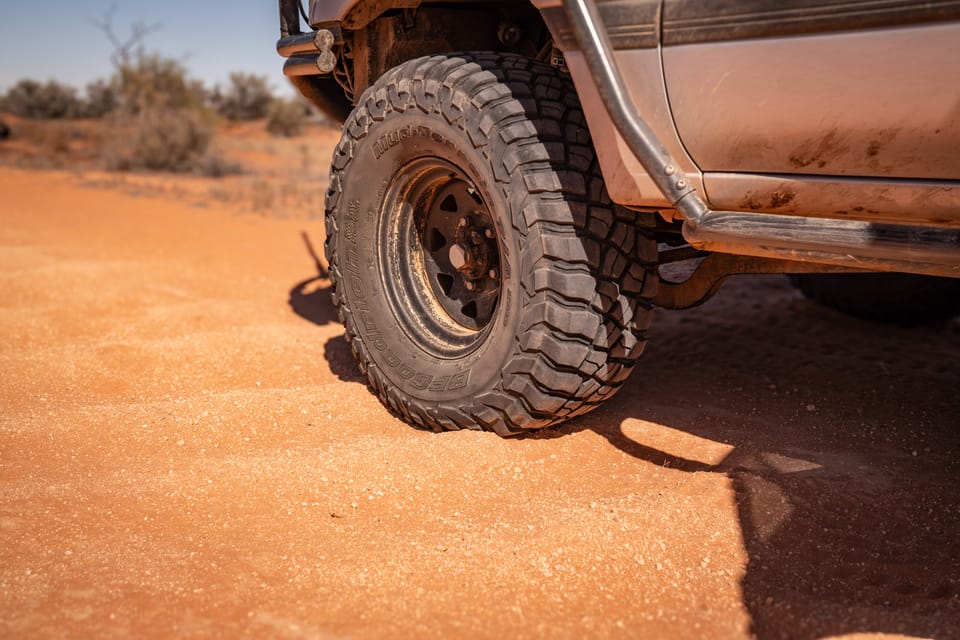
The dunes are not what breaks vehicles out here. Corrugation is.
Corrugation kills shocks, cracks water tanks, shakes roof racks loose, splits brackets and undoes fasteners you did not know existed. It does it slowly, over hundreds of kilometres, and most people only find out at camp when something is hanging off. On one Hay River trip I stopped at the dog leg and found parts of somebody's vehicle lying on the track. A cargo barrier, a section of roof, a tray. They had been there long enough to grow spider webs.
This is a guide to where the Simpson corrugates, why those particular tracks are so bad, and what actually works when you are driving them.
Which Simpson Desert tracks are the most corrugated?
Not all of them, and not evenly. The dune country is often reasonable. The trouble is on the harder gravel and clay-based sections that carry steady traffic and get no maintenance.
The southern Hay River Track is the worst of it. The 58 kilometres from Beachcomber Oil Well 1 down towards Poeppel Corner are, in my experience, the worst corrugation the Simpson has on offer. Absolutely bone shattering. It is not something I remember fondly. All up you are looking at around 75 kilometres of severe corrugation between Beachcomber and the French Line.
The northern Hay River is not much better. Around 80 kilometres of very bad corrugation runs from the northern end down to Batton Hill.
Mount Dare to Purni Bore. This is where a lot of crossings start and it is frequently one of the roughest stretches of the whole trip. Steady traffic, not deep sand, often badly corrugated. It is also right at the beginning, before you have settled into a rhythm and before you have found out whether the load in the back is packed properly. A lot of gear damage happens in the first two hours of a Simpson trip.
The Rig Road. It was clay-capped and it used to be the least demanding crossing in the desert, which is why it still gets recommended for anyone towing. It has deteriorated a lot over the past few years and there is bad corrugation in places now. It is a made road, and a firm base holds a washboard far better than soft sand ever will.
It is also getting worse generally. Across more than twenty crossings I have hardly ever seen the desert improve, and given the traffic it carries now that is not surprising.
Why is the Hay River Track so much rougher than the dunes?
Because the bottom end of it is not sand.
That section is a corrugated gravel road, close to a gravel highway in places, built for mining traffic. Firm base, steady traffic, no grader. That combination holds a washboard pattern indefinitely.
Sand does not do this to you. It moves, it reforms, and it will not hold a sharp ripple. Gravel and clay will, and they will keep it for years.
This is the thing that catches people out about the Simpson. Everyone prepares for a sand crossing, and a good part of the route is not sand at all.
What actually causes corrugation?
Not bad driving, which is the answer you usually get.
Corrugation is what loose material does under a rolling wheel. Physicists at Cambridge tested it by rolling a wheel over a flat bed of sand, and ripples appeared on their own after only a few passes. Below about 8 km/h nothing happened. Above it, the flat surface simply could not stay flat.
Two things follow, and both contradict the campfire version.
Nobody out here is driving slowly enough to prevent it. The threshold is walking pace. Every vehicle crossing the Simpson is well above it, so every vehicle contributes, including the slow careful ones.
Your suspension does not carve them. The follow-up Cambridge work addresses this directly and calls it incorrect. Ripples formed with no suspension in the system at all.
What genuinely tears up a track is pushing sideways at the tyre, not bouncing on it. Accelerating and braking do far more damage than steady speed does, and driven wheels dig in more than towed ones. Out here that means the worst corrugation builds where people are constantly on and off the throttle: dune approaches, tight sections, and anywhere convoys are stopping and starting.
If you want to be gentle on the desert, drive smoothly. That matters more than driving slowly.
How fast should you drive on corrugation?
Faster than most people tell you, and this is the part that starts arguments.
There is a band, roughly 30 to 50 km/h, where everything shakes hard. Above it, on the graded and connecting sections, my vehicle settles somewhere between 70 and 90. You can feel the moment you find it. The hammering turns into a hum and the noise drops away.
The short reason is that your wheel and tyre assembly has a rate at which it likes to bounce, somewhere around 10 to 15 times a second in most vehicles, and corrugation at 30 km/h feeds bumps in at almost exactly that rate. That is the worst case. Drive well past it and the wheel runs out of time at both ends. It never quite reaches the bottom of the trough or the top of the crest, so it travels a shallower path than the track underneath it.
That does not mean the wheel floats along the crests. Film your tyres from outside the vehicle at speed and they are still working hard. They are just not going as deep or as high as the road is.
I worked this out by driving, not by calculation, and the clearest evidence I have is a broken camera mount. A GoPro bracket on my bull bar shook itself to pieces at low speed on corrugation. The replacement, run faster on the same sort of track, survived thousands of kilometres. Same bracket, same vehicle, one variable.
I have written the full argument out on ALLOFFROAD, in Corrugations: Speed, Suspension and the Smooth Zone. If you want the detail, including why "force equals mass times acceleration" gives the opposite answer to the one most people assume, read that one.
Three conditions have to be true before any of it applies to you, and in the desert they matter more than the speed itself.
Do you need good shocks for the Simpson Desert?
For this technique, yes, and it is the condition people skip.
A shock absorber works by pushing oil through small holes, which turns movement into heat. That is its job. At 80 km/h you are covering nearly three times the ground per hour as at 30, so you pass over nearly three times as many corrugations. Each hit is smaller, but they arrive constantly and they do not stop for hours.
When shock oil gets too hot it thins and starts to foam. Foamy oil is compressible, so it slips through the valving instead of being worked, and the shock goes soft. That is shock fade, and once it happens your wheel is not being controlled at all. The entire faster-is-easier approach depends on the damper holding that wheel, so lose damping and you lose the whole benefit.
This is where oil capacity earns its money. A remote reservoir gives the shock more oil and more surface area to shed heat through, so the damping stays consistent through a long desert day instead of fading out after the first hour.
For disclosure, since it is context for the speeds above rather than a recommendation: I ran Icon 2.5 inch remote reservoir shocks for years, rebuilt at 80,000 km of hard driving, and I now run Superior Engineering 2.5 inch monotube remote reservoir shocks, three-way adjustable, on custom-wound springs for a loaded weight between 3.6 and close to 4 tonnes.
If your shocks are tired, or were never built to shed that much heat, you will not get the smooth zone and going fast will punish you. Sort the suspension before the trip, not after it.
What tyre pressure should you run in the Simpson Desert?
Set for the surface, not for the corrugation.
- Sand: start at rim size in psi. So 17 psi on a 17 inch rim.
- Remote gravel and fire trails: come down 20 to 30 percent off your on-road pressure, which lands most touring rigs around 28 to 32 psi.
Both are rough starting points, not answers. Vehicle weight, tyre size and tyre construction all move the number and you adjust once you can see how the tyre is sitting under load.
A Simpson crossing is both surfaces, and that is what catches people out. The desert is overwhelmingly sand with hard corrugated gravel sections in it, the bottom of the Hay River being the obvious one.
I do not chase that. I set for the sand, run between 17 and 20 psi, and leave it there for the crossing. Airing up and down for a 58 kilometre gravel section costs time, fuel and compressor life and gains very little, and the lower pressure is doing useful work on the corrugation anyway.
What you should not do is run gravel pressures across the desert because part of it is gravel. Hard tyre plus fast hit is what breaks tyres out here, and you are a long way from a replacement.
When should you slow down?
Everywhere the sight lines are short, which in the Simpson is a lot of places.
Grip on corrugation comes and goes as the load on each tyre rises and falls, and at speed you have less time to react on top of that. Longer stopping distances, less in reserve in a corner.
Slow down for blind dune crests, corners, anywhere you might meet oncoming traffic, and anywhere you cannot see far enough ahead to stop. The faster approach is for the open graded runs, not for the whole crossing. Knowing which is which is most of the skill.
What corrugation actually breaks
Worth knowing what to check, because it is never the thing you expect.
On my crossings I have had a portable shower die, sand flags rattle loose in their mounts, and a trailer come apart. I have watched other people stop to re-secure roof racks that were working themselves off. The parts I found lying at the Hay River dog leg belonged to someone who presumably did not notice until much later.
Check every night, not every few days. Bolts, roof rack fittings, water tank straps, anything mounted to the bull bar, and every fastener holding something heavy. Corrugation finds them all eventually and it does not care how well you were driving. A bit of duct tape around a loose sand flag mount is not elegant, but it works, and it beats losing the flag.
The bottom line
The Simpson corrugates because loose material under a rolling wheel does that above walking pace. Nobody is preventing it, your suspension does not cause it, and driving slowly does not save the track.
The worst corrugation is on the southern Hay River, roughly 75 kilometres of it between Beachcomber and the French Line, with the 58 kilometres down towards Poeppel Corner the hardest of the lot. The northern Hay River, the Mount Dare run and parts of the Rig Road are not far behind.
On the open sections a bit more speed is genuinely easier on the vehicle, but only if your shocks can control the wheel and stay cool enough to keep doing it all day, your tyres are down, and you can see far enough ahead to justify it. Take any one of those away and slow down.
Corrugation is one chapter of a much bigger planning problem. Fuel range, water, permits, which route to take and in which direction, what to do about a flat tyre 300 kilometres from anywhere, and how much of the gear you are about to buy you actually need.
The Simpson Desert 4WD Travel Guide covers all of it across 260 pages, built from more than twenty crossings. Track-by-track notes, fuel and water calculations, vehicle preparation, recovery, camping and the history of the country you are driving through.
If you want to see what is in it first, there is a full table of contents and a packing list on this site.